 World Stroke Organization
 Infographic on Advances in oral anticoagulation for stroke prevention
06 Jan 2025Infographic created by E. Adams (2024), © World Stroke Organization
Advances in oral anticoagulation for stroke prevention
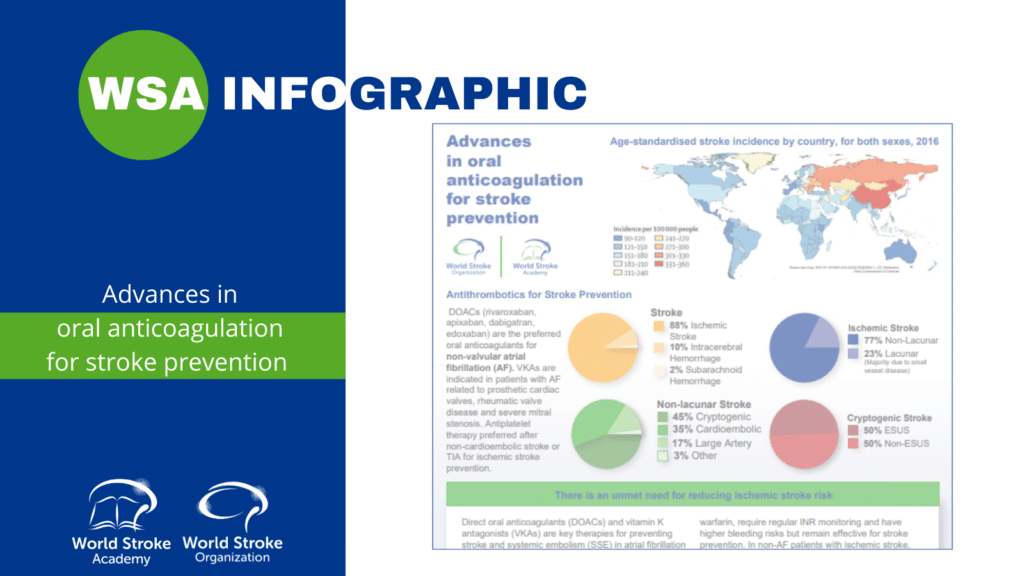
Infographic created by E. Adams (2024), © World Stroke Organization
References: 1. DOI: 10.1093/eurheartj/ehaa612 | 2. DOI: 10.1093/eurheartj/ehw210 | 3. DOI: 10.1016/S0140-6736(13)62343-0
Background
Stroke remains a major global health challenge, with ischemic stroke accounting for the vast majority of cases. Atrial fibrillation (AF) is a key risk factor for ischemic stroke, substantially increasing the likelihood of cardioembolic events over a patient’s lifetime. Despite advances in prevention strategies, there remains an unmet need to reduce stroke risk while minimizing bleeding complications associated with long-term anticoagulation.
Oral anticoagulants play a central role in stroke prevention, particularly in patients with AF. While direct oral anticoagulants (DOACs) have transformed clinical practice, ongoing research continues to explore new therapeutic targets aimed at improving safety without compromising efficacy.
Introduction
To support healthcare professionals in understanding developments in this evolving field, the World Stroke Academy has developed an educational infographic titled “Advances in Oral Anticoagulation for Stroke Prevention.” The infographic provides a structured, visual overview of current oral anticoagulant therapies and emerging approaches under investigation for stroke prevention.
Key educational themes
-
The global burden and epidemiology of ischemic stroke and atrial fibrillation
-
The role of DOACs and vitamin K antagonists in stroke prevention, including current indications
-
Differences in antithrombotic strategies across cardioembolic and non-cardioembolic stroke subtypes
-
Emerging evidence on Factor XI / Factor XIa inhibition as a potential approach to uncouple thrombosis from hemostasis
-
Ongoing and completed clinical trials evaluating novel oral anticoagulants in both AF and non-cardioembolic ischemic stroke
By consolidating complex trial data and mechanistic concepts into an accessible format, the infographic aims to facilitate clinical reflection and ongoing education in oral anticoagulation for stroke prevention.
Educational grant disclosure
This infographic and accompanying educational content were developed with the support of an unrestricted educational grant from Bayer AG who had no influence over content development, data interpretation, or editorial decisions. The views expressed are those of the authors and the World Stroke Academy.
→ Access full infographic here: Advances in oral anticoagulation for stroke prevention
Related education
 ;
;